
Why Change Is So Hard — And What Actually Works

Here is the neuroscience behind why change feels impossible — and the proven framework to make it stick.
We've all been there — the gym membership gathering dust, the course you never finished, the promise that this time would be different. Change is hard. But it's not a character flaw. It's biology.
Most people dive into the what of what they want to change and skill-building without ever reckoning with the why behind their own resistance. Understanding that is the real difference between lasting growth and another abandoned attempt.
The Root Cause: Why Our Brains Work Against Us Initially
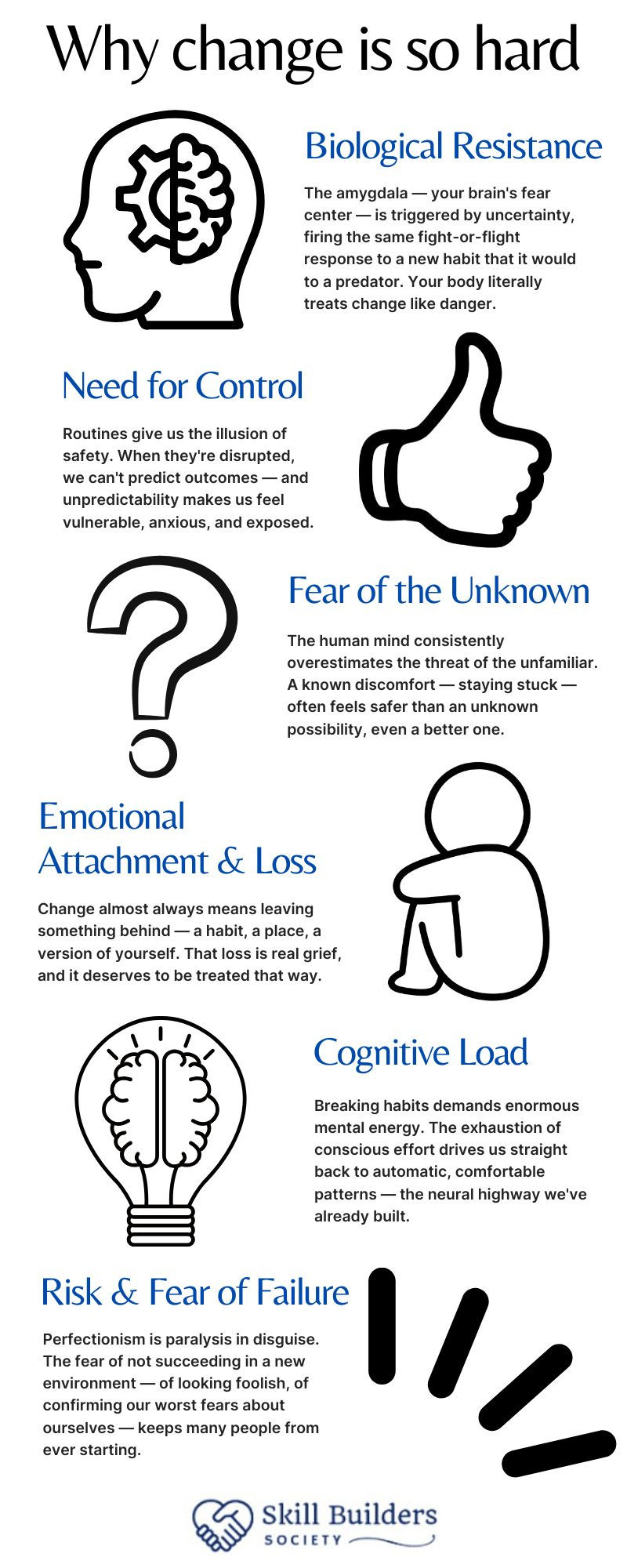
Your resistance to change is, at its core, a feature — not a bug. The human brain evolved around survival, and survival has always depended on predictability. Novelty is perceived as threat.
"The brain's preference for safety and efficiency makes it naturally resistant to adopting new behaviors — even when those behaviors would clearly benefit us." — Neuroscience Research
When you try to pick up a new skill — coding, a language, public speaking — you hit a wall not because it's too hard, but because the act of changing yourself triggers your brain's defenses. That wall isn't a sign you're on the wrong track. It's a sign you need a better strategy.
"Most people who try to learn a new skill don't fail because they lack talent — they fail because they underestimate how much their brain is working against them from day one." — The Hidden Cost of Skill Acquisition
Here are the six forces your brain deploys every time you try to do something new:
The Framework: How to Build Habits That Actually Stick
James Clear's Atomic Habits offers a practical, neuroscience-aligned system built on a simple truth: every habit has a loop — cue → craving → response → reward. To build good habits, optimize each stage. To break bad ones, interrupt them.

The Inversion: Breaking the Habits Holding You Back
The same four laws apply in reverse when eliminating a habit — make the unwanted behavior invisible, unattractive, difficult, and unsatisfying.
Focus on systems, not goals. A goal is a destination; a system is the vehicle. Fall in love with the process of becoming 1% better each day — and the outcomes take care of themselves.
The Application: Putting It All Together for Skill-Building
Learning a new skill is one of the most rewarding — and most abandoned — pursuits a person can undertake. People quit not from lack of talent, but because they walk into skill acquisition without understanding what they're signing up for: a sustained act of personal change, in the face of a brain actively lobbying them to stop.
When you understand the biology of resistance and apply Clear's four laws deliberately, you stop fighting yourself — and start designing a learning environment that makes growth feel almost inevitable.
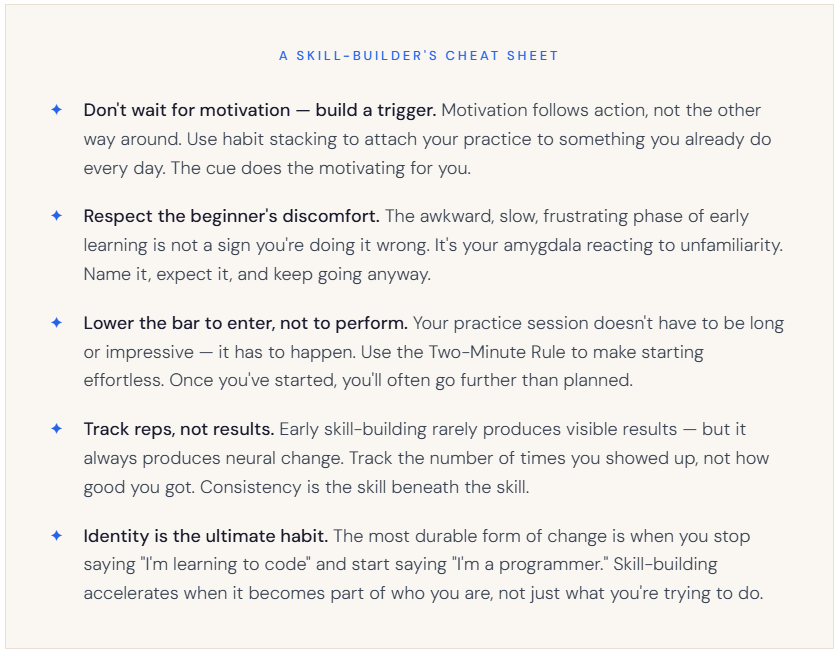
The people who successfully develop new skills aren't the most talented or the most motivated — they're the ones who engineered their environment, lowered the threshold to begin, and gave their brain enough small wins to stay in the game long enough for real ability to emerge.
The Takeaway: Small Shifts, Lasting Change
Change is hard because your brain is doing its job — protecting you from the unfamiliar, conserving energy, keeping you on the path of least resistance. That's not a weakness to overcome through sheer grit. It's a system to understand and redesign.
Make the desired behavior obvious, attractive, easy, and satisfying. Remove friction. Build identity. Celebrate small wins. Trust that 1% improvements, compounded over time, produce results that feel nothing short of remarkable.
As James Clear writes, you don't rise to the level of your goals — you fall to the level of your systems. Build better systems, and the person you want to become will meet you there.
References: James Clear, Atomic Habits (2018) · Psychology Today · Neuroscience & Behavioral Research
Dianne A. Fanti, MS, CPC, is an author, trainer, skill-building specialist, and Certified Professional Coach specializing in helping people overcome limiting beliefs, to realize their full potential. She is the founder of the Skill Builders Society.


Comments